
4 Topper Strategies and Books for Cracking Your TRANSCO, GENCO, or DISCOM Exam
Looking for the best strategies and Transco DESCO GNECO preparation books in India? We reveal 4 topper secrets, including the best electrical/written exam books recommended for 2025.
PSUS
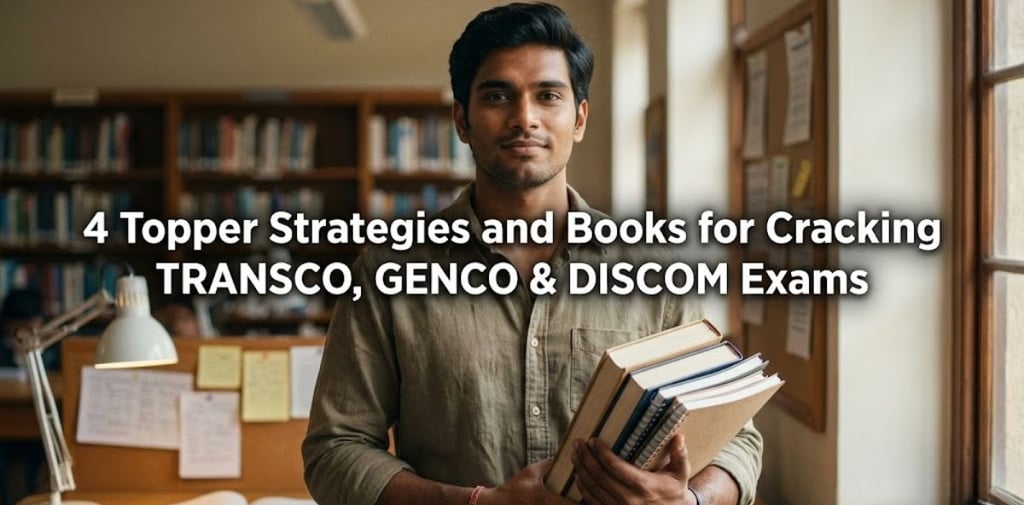
Preparing for competitive power sector exams like TRANSCO, GENCO, and DISCOMs is a dream for many aspiring engineers. However, faced with high competition and limited vacancies, the path to success can often feel overwhelming and unstructured.
The purpose of this guide is to Clarify the preparation process by providing a clear, step-by-step Process. We will transform what seems like a monumental task into a manageable and structured journey, guiding you from your first day of study to the final exam.
Your journey begins not with a book, but with the official plan.
🚀 Join 7,000+ Engineers on Telegram
Phase 1: Charting Your Course Understanding the Syllabus
Before you purchase a single book or attempt to solve any problems, your absolute first action must be to download and thoroughly analyze the official notification syllabus for the exam you are targeting.
Treat this syllabus as the official blueprint for your success. It tells you exactly where to focus your energy, reveals the weightage of different subjects, and prevents you from wasting a single hour on topics that won't be tested. By mastering the syllabus first, you create a solid, reliable map for the road ahead.
With this blueprint in hand, you are now ready to build your knowledge.
Phase 2: Building a Strong Foundation Mastering the Core Concepts
With the syllabus as your guide, the next phase is to build deep conceptual clarity. This is achieved by studying from standard, expert-recommended reference books that have stood the test of time.
For Electrical Engineering (EE)
Since Electrical Engineering is the primary branch for these power sector exams, the recommended resources focus on building a strong command of core concepts from the ground up.
• Basic Electrical Engineering (V.K. Mehta / Rohit Mehta): Ideal for understanding the fundamental basics of DC/AC circuits and Machines.
• Power Systems (C.L. Wadhwa): Essential for mastering the crucial transmission and distribution sections of the syllabus.
• Electrical Engineering Objective Type (J.B. Gupta): A key resource containing thousands of practice questions designed to improve your problem-solving speed.
For Mechanical (ME) & Civil (CE) Engineering
Based on the "Power Sector Exam Preparation Guide and Book List," the recommended resources and strategies for Mechanical and Civil Engineering candidates are detailed below. The guide highlights that while Electrical Engineering is the primary focus of these exams, specific strategies are necessary for other branches where dedicated "Transco Books" are rare.
Mechanical Engineering Resources
For Mechanical Engineering aspirants, the sources emphasize using standard, widely recognized textbooks to cover core technical subjects.
• Core Textbooks:
◦ R.S. Khurmi & J.K. Gupta: described as the "gold standard" for covering Strength of Materials (SOM), Theory of Machines, and Thermodynamics.
◦ R.K. Bansal: Highly recommended specifically for Fluid Mechanics and Hydraulic Machines.
Civil Engineering Resources & Strategy
The approach for Civil Engineering requires a combination of a comprehensive objective book and a broader practice strategy due to the scarcity of exam-specific materials.
• Primary Textbook:
Civil Engineering: Conventional and Objective Type" by R.S. Khurmi: This book is recommended to effectively cover key topics such as Concrete Technology, Soil Mechanics, and Structures.
• Strategic Practice (Crucial for Civil):
Generic PSU Papers: The sources explicitly state that "no specific book exists" for Transco Civil Engineering exams. Therefore, the most effective strategy is to solve generic PSU papers from major organizations like NTPC or BHEL. This helps candidates master the question patterns and scope in the absence of dedicated state-level power sector books.
Universal Strategy (All Branches)
Regardless of the branch, the sources advise that candidates must not ignore the non-technical sections.
• Aptitude: 20–30% of the marks come from General Awareness and Mathematics; R.S. Aggarwal is the recommended resource for this section.
• Focus Distribution: The ideal effort distribution is 70–80% on technical core subjects and 20–30% on aptitude.
To view this strategy through an analogy: For Civil candidates, preparing without a specific "Transco" book is like cross-training for a specific sport using general gym equipment; while the equipment (Generic PSU papers) isn't custom-built for that one event, it builds the exact same muscles (concepts and problem-solving skills) required to win.
Phase 3: Sharpening Your Brain The Power of Practice
Conceptual knowledge alone is not enough to clear these competitive exams. True success comes from solving a vast number of previous years' papers to understand question patterns, manage time effectively, and gain a competitive edge. It's important to remember that state-level exams often repeat questions from older sets.
There are two primary approaches to practice, each serving a unique purpose in your preparation:
1. Topic-Wise Practice For reinforcing concepts as you learn them, the GENCO / TRANSCO / DISCOMs Electrical Engineering – Practice + Theory (ACE Engineering) book is an excellent resource. Its key benefit is its structure; you can study a chapter from your reference book and then immediately practice over 100 questions on just that topic. This instantly solidifies your understanding.
2. Full-Length Paper Practice To simulate the real exam environment, use the Practice Book for GENCO, TRANSCO & DISCOMs (Made Easy Publications) and Electrical Engineering Previous 29 Papers. These books are invaluable for understanding the overall difficulty level of the exam. Most importantly, they are crucial for practicing time management, a skill that is best honed in the final month of preparation by solving complete papers under timed conditions.
With your concepts clear and your practice regimen established, you can now integrate them into a winning formula.
Phase 4: The Winning Strategy Bringing It All Together
Having the right books is only half the battle. A disciplined, intelligent strategy is what separates the toppers from the rest of the aspirants.
The core strategy to integrate all your efforts for maximum impact:
1. Prioritize Your Core Recognize that 70-80% of the total marks will come from your core technical subjects. This area must be your primary focus, receiving the majority of your study time and attention.
2. Don't Ignore the Deciders The remaining 20-30% of marks, which come from sections like General Awareness and Maths, are often what determine your final rank. Do not neglect this portion. For a strong preparation in this area, R.S. Aggarwal is the recommended resource.
3. Revise Systematically Consistent revision is non-negotiable for success. To make this process efficient and effective, adopt the "Short Notes" method. Creating concise notes as you study allows you to quickly review vast amounts of information in the weeks leading up to the exam.
By executing these four phases with discipline charting your course, building your foundation, sharpening your skills, and applying a winning strategy you transform an overwhelming challenge into a clear path to victory.
Conclusion: Your Journey Starts Now
By following this clear, four-phase pathcharting your course with the syllabus, building a deep conceptual foundation, honing your skills through practice, and executing a winning strategyyou can navigate your exam preparation with confidence. The journey is challenging, but it is absolutely achievable. With the right strategy, the right resources, and consistent effort, your goal is well within reach. Your journey starts now.
❓ Frequently Asked Questions (FAQs)
Q1: Which is the best book for Transco Electrical AE exam preparation?
Ans: The most recommended books are the ACE Engineering Academy Practice Book (for concept-wise questions) and Made Easy Previous Papers (for solving past exam papers).
Q2: Is there a specific Transco preparation book for Civil or Mechanical Engineering?
Ans: No specific book exists for these branches. Toppers recommend standard books like R.S. Khurmi and J.K. Gupta, along with previous PSU papers (NTPC/BHEL).
Q3: What is the weightage of the syllabus in Transco exams?
Ans: Typically, 70-80% of the marks are from Core Technical subjects (Electrical/Mech/Civil), and 20-30% are from General Awareness and Aptitude.
Q4: Should I study theory or focus on objective questions?
Ans: A balanced approach is best. Use V.K. Mehta for basic theory, but focus 70% of your time on solving objective questions from J.B. Gupta or ACE Academy books.
Copyright © 2026 electricwisers. All rights reserved.
The most trusted exam preparation site for competitive exams. Trusted by thousands of students every day. Free, quality learning for a brighter future.
Never miss any updates, follow us on